
The page is for Professional Intermediaries, as defined by the FCA, and should not be relied upon by Retail Clients
Retail Clients can view Mercia's investment opportunities available for them here
Inheritance tax on pensions
Your clients will have a new large IHT liability from April 2027
Pensions now
For many years, pensions have been outside of Inheritance Tax, and have been the main strategy for the UK population building long-term wealth.
Currently, for example, a £3.5m pension has no IHT liability, but income tax is payable for the beneficiaries.
The net distributed amount is £1.925m, with a 45% effective tax rate.
Pensions after 2027
The loophole of using pensions for legacy planning is being closed. After April 2027, pensions will be included in the IHT estate, and proceeds will also be taxed as income.
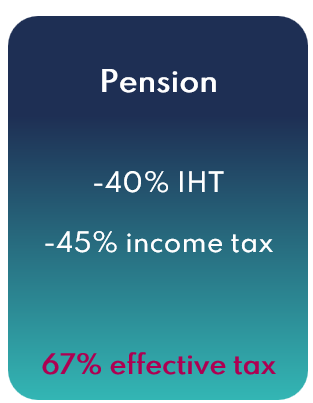
For the same £3.5m pension after 2027, there would be a 40% IHT charge, and descendants would also incur income tax.
The net distributed amount would be £1.155m, with a 67% effective tax rate.
Strategies to mitigate IHT on pensions:
-
Phased drawdown to reduce taxable pension pot ✔️
- Via your client's use of their tax-free lump sum
- We reference a 45% income tax liability on pension withdrawal, which is (almost) the worst-case scenario ¬
-
Gifting and trusts❓
- Issues include the lack of control, access to capital and complexity
- It is currently unclear whether pension capital can be regularly released and gifted from excess income
-
Whole of life insurance❓
- The premiums will be very expensive, if possible
- A 80-year-old with a £3.5m pension, would pay £64k pa to cover the additional tax, or £176k pa to cover the full tax liability
- Whole of life insurance is unlikely to be available for clients over 80, smokers, or clients not in perfect health
-
Tax-efficiently reinvest pension capital, via*:
Considerations
Your clients will have a large additional IHT liabilty from April 2027
increased IHT liabilities range from £4k (£0.5m pension) to £2.32m (£10m pension)
Reallocating pension capital takes time and complex planning
We can provide you with options to manage your clients IHT
Strategies to mitigate IHT on pensions*:

Status quo
If no action is taken, two-thirds of your client's pension will be lost in tax, first through IHT and then through income tax to the descendants (64% for a 40% marginal tax rate, as per the AI illustration).
There is powerful drive for your clients to take your advice, and many new HNWIs will be seeking advice.
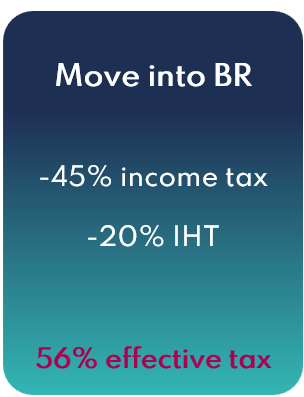
BR replaces pension
Other than gifting, and assuming whole of life insurance is too expensive (/not possible), then investing pension capital in BR funds could be considered.
Productised BR funds are available, aiming (not always successfully) to offset inflation (no growth), but importantly to provide monthly liquidity.
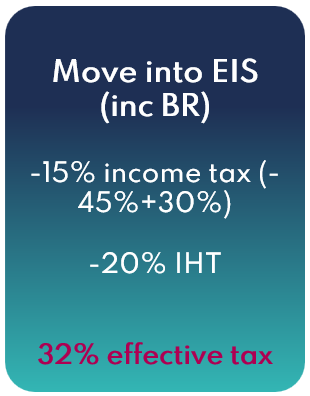
EISs are very tax-efficient
From a tax-efficiency perspective, EISs are the most attractive, with a range of benefits. However, EISs are the most volatile and illiquid option.
If the client understands the risks, the income tax relief, BR qualification, and downside protection are very attractive.
If the EIS is well managed, the returns can be very attractive. Capital is at risk and is totally illiquid.
Time until your client gets a significant IHT liability
Independent opinions
Model of pension reallocation to a mixture of tax-efficient strategies, including EIS, VCT and BR
Please use our model to investigate the impact of releasing pension capital, assuming no tax-free lump sum or phased withdrawal.
The model shows the benefits of EIS and VCT versus BR investment, partially driven by the availability of 30% income tax relief.
¬ External sites are AI-generated, via Claude from Anthropic, are partially manually checked, but cannot be entirely relied upon. We are providing this information to you as an investment professional, to make your best judgment. References are shown in some cases.

![TA]](https://hub.mercia.co.uk/hs-fs/hubfs/TA%5D.png?width=732&height=161&name=TA%5D.png)